Views: 2 Author: Site Editor Publish Time: 2026-09-08 Origin: Site


A self-service car wash machine lets customers wash their own vehicles using coin, card, or app-based payment systems, combining high-pressure water, foam, and vacuum functions in one unit. These machines suit business owners looking for a low-labor, high-margin investment, with entry-level units starting around $3,000–$8,000 depending on features like liquid crystal displays and pump power.
Car washing has changed. Fewer people want to spend their Saturday afternoon scrubbing their car by hand, and fewer still want to pay premium prices for a full-service wash they could do themselves in ten minutes. That gap has created a booming market for self-service car wash machines, equipment that lets customers do the work themselves using professional-grade tools.
For entrepreneurs and car wash operators, this shift represents a genuine business opportunity. A self-service car wash setup requires less staff, less overhead, and far less time to become profitable than a traditional automatic wash bay. But choosing the right machine to wash car exteriors and interiors, one that balances price, durability, and features, takes some research.
This guide breaks down how self-service car wash machines work, what to look for when buying one, and how to compare popular configurations before you invest.
A self-service car wash machine is a coin- or card-operated unit that gives customers direct access to high pressure car wash tools, foam applicators, and vacuum systems. Instead of an attendant washing the vehicle, the customer controls the equipment themselves, typically for a set time period tied to their payment.
Most modern car washing machines combine several functions into a single console:
High-pressure water jets for rinsing dirt and grime
Foam or bubble guns for pre-soak and soap application
Vacuum cleaners for interior cleaning
Payment systems supporting coins, cards, mobile payments, or membership apps
This all-in-one design is why self-service car wash for sale listings have grown so common across the equipment market. Business owners can install a handful of units in a small lot and let customers self-serve, cutting labor costs dramatically compared to full-service washes.
Three factors are driving demand: lower operating costs, faster ROI, and customer preference for control and speed.
Lower operating costs. A self-service car wash machine for business use doesn't require a full-time attendant. Most units run on automated settings, with remote monitoring available through background management systems.
Faster ROI. Because the equipment does most of the work, owners can operate multiple wash bays with minimal staffing. Many commercial-grade machines include multi-merchant management features, allowing one operator to run several locations from a single dashboard.
Customer control. Some drivers prefer washing their own car, either for cost savings or because they want to focus attention on specific spots automatic washes might miss. Self-service car wash machines cater directly to that preference.
Not all self-service car wash machines are built the same. Before buying, compare pump power, water pressure, tank capacity, and included features like displays or payment integrations.
Water pump size determines how effectively the machine can strip dirt from a vehicle. Commercial units typically range from 2.2kW to 3.0kW, with corresponding water pressure between 110kg and 150kg. Choose a higher-powered pump if you're targeting commercial vehicles, trucks, or heavily soiled cars; a lower-powered unit is often sufficient for passenger vehicles in cleaner climates.
A liquid crystal display gives customers a clear interface for selecting wash modes, checking remaining time, or viewing pricing. It's not essential, but it improves the customer experience and can reduce confusion or complaints, particularly for first-time users unfamiliar with self-service equipment.
If you're planning to scale beyond one wash bay, prioritize machines with remote configuration, income tracking, and multi-merchant management. These features let you monitor and adjust settings, such as unit pricing for water, foam, or vacuum, across every unit for business use without visiting each site.
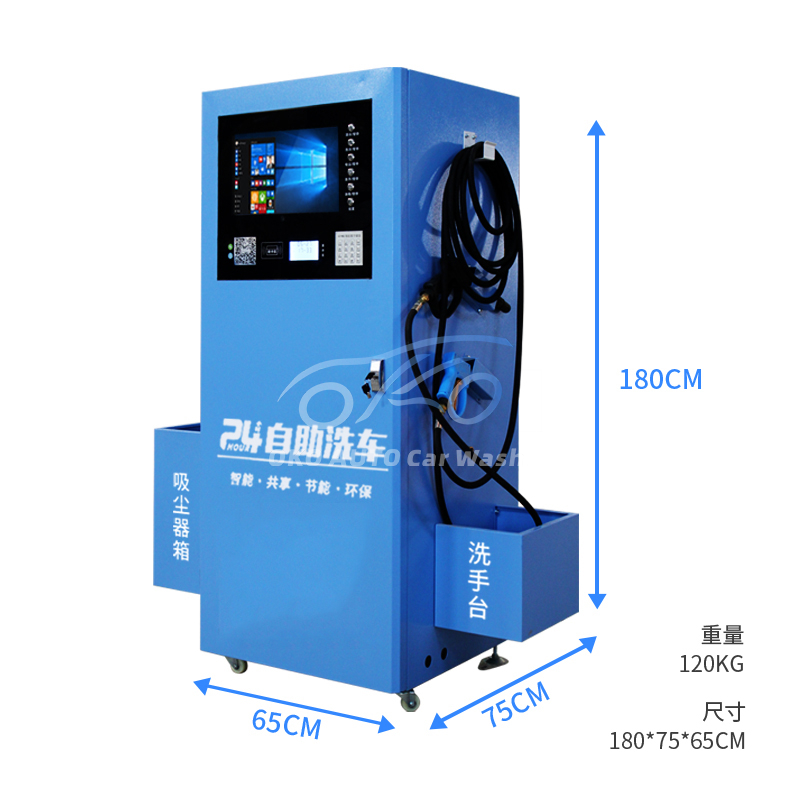
To illustrate how these features vary across machine tiers, here's a comparison based on three commercial self-service car wash machine models (OK-308, OK-208, and OK-108) commonly available for purchase from equipment manufacturers like OKO Carwash.
Feature | OK-308 | OK-208 | OK-108 |
|---|---|---|---|
Size | 75cm x 65cm x 180cm | 75cm x 65cm x 180cm | 65cm x 60cm x 170cm |
Liquid Crystal Display | Yes | No | No |
Water Pump | 3.0kW commercial | 2.5kW commercial | 2.2kW commercial |
Bubble Gun | Pure copper high pressure kit | Pure copper high pressure kit | Not included |
Water Tank | 60L | 60L | 20L |
Water Pressure | 150kg | 130kg | 110kg |
Net Weight | 120kg | 120kg | 90kg |
Payment Methods | WeChat, Alipay, credit card | WeChat, Alipay, credit card | WeChat, Alipay, credit card |
As the table shows, the higher-tier OK-308 model offers more pump power, a larger tank, and a display screen, features better suited to high-traffic locations. The OK-108 is a smaller, budget-friendly option that still delivers core wash functions, making it a reasonable entry point for businesses testing the self-service model before scaling up.
Choose the OK-308 (or similar high-spec units) if display convenience and higher throughput matter more than upfront cost. Choose the OK-108 tier if you're prioritizing a lower initial investment over premium features.
If you're shopping for a self-service car wash machine for sale, start by defining your budget, expected customer volume, and available space. Machines with larger tanks and higher-powered pumps cost more upfront but tend to handle higher traffic without frequent refilling or maintenance.
It's also worth confirming what accessories and support come included. Many suppliers bundle starter kits, such as foam bottles, membership cards, and flow monitoring cards, along with the machine itself, which can reduce your initial setup costs.
Before finalizing a purchase, request the manufacturer's full spec sheet and compare it against your projected customer volume. A machine built for light residential use won't hold up under constant commercial demand, and oversized equipment for a low-traffic location wastes both water and money.
Self-service car wash machines offer a practical path into the car care industry without the overhead of a full-service operation. The right choice depends on your location's traffic, your budget, and how much you want to scale.
Start by identifying two or three models that fit your price range, then compare their pump power, tank size, and payment features side by side. From there, reach out to suppliers directly for quotes and installation details. A well-chosen machine can start paying for itself within months, especially in high-traffic areas where customers value speed and convenience over full-service pampering.
How much does a self-service car wash machine cost?
Prices vary by pump power, tank size, and included features like displays. Entry-level units with smaller pumps and tanks are generally more affordable, while higher-spec machines with larger pumps, bigger tanks, and LCD displays cost more.
How much space does a self-service car wash machine need?
Most commercial units measure roughly 65cm to 75cm wide and 170cm to 180cm tall, plus space for hoses, vacuum equipment, and customer access. Plan for enough clearance around each unit for vehicles to park comfortably during use.
Can one person manage multiple self-service car wash locations?
Yes. Many commercial machines include background management systems that support multi-merchant oversight, remote configuration, and income tracking, allowing a single operator to manage several sites without being physically present at each one.
What payment methods do self-service car wash machines support?
Most modern units accept multiple payment types, including mobile payment apps, credit cards, and membership cards, giving customers flexibility and reducing reliance on cash transactions.
Are self-service car wash machines suitable for cold climates?
Many commercial machines are rated to operate in temperatures as low as -15 degrees Celsius, though performance and water flow can vary by model. Confirm the working temperature range with the manufacturer before installing in colder regions.


Add